









Word Count: Approx. 1,500 words | Reading Time: About 7 minutes
How much walking is enough each day? When tracking daily activity, most people focus on two numbers: steps and distance.
Some people aim for 10,000 steps a day, while others care more about whether they have walked 4.8 km (3 miles). But neither metric is automatically more important. They simply measure different parts of your activity.
Daily steps count how many times your feet hit the ground. Walking distance measures how far you actually travel. Between the two is another important variable: stride length.
That means your step count and walking distance will not always increase at exactly the same rate.
If your goal is to see whether you are moving more throughout the day, daily steps are usually easier to track. If you want to measure a specific Walking Pad or treadmill workout, distance is often more useful.
10,000 steps does not always equal 8 km (5 miles). Height, stride length, walking speed and walking style can all change how much distance those steps actually cover.
1. Should You Track Steps or Distance? For Daily Activity, Start With Steps
One of the biggest advantages of tracking daily steps is that they capture all the small amounts of movement that happen throughout your day.
Walking to the car park in the morning, going out to buy coffee at lunchtime, moving around the office, or taking a 20-minute walk after dinner may not feel like complete workouts on their own.
But they all contribute to your daily step count.
Each of these short walking breaks might add only a few hundred steps. Repeat them throughout the day, though, and they can add up to several thousand steps—even if no individual walk reaches 1.6 km (1 mile).
So if your goal is to reduce sedentary time and increase daily activity, step count is often more useful than distance for understanding your overall movement habits.
That does not mean you need to treat 10,000 steps as a mandatory daily target.
The Physical Activity Guidelines for Americans recommend that adults complete 150–300 minutes of moderate-intensity aerobic activity each week, along with muscle-strengthening activity on at least two days each week. The guidelines do not set a universal number of steps that everyone must complete each day.
In other words, a step tracker is better used to understand your current activity level, monitor changes and set a goal that makes sense for you.
A 2017 review published in Sports Medicine also noted that steps are intuitive and easy to measure, making step counts useful for assessing everyday walking activity.
Instead of constantly asking, “Did I reach 10,000 steps today?”, it may be more useful to ask whether you are walking more than you used to—or spending less of your day sitting.
2. When Should You Track Distance? For a Walking Pad or Treadmill Workout, Distance Can Be More Useful
If today's goal is to walk on a treadmill for 30 minutes or complete 3.2 km (2 miles), walking distance gives you a clearer picture of that specific workout.
For example, two people can both walk 4,000 steps without covering exactly the same distance.
One person might walk close to 3.2 km (2 miles), while another may cover less.
The reason is simple: not everyone covers the same distance with each step.
For a Walking Pad or treadmill workout, distance can be especially useful for tracking questions such as:
- Did you walk 1.6 km (1 mile) or 3.2 km (2 miles) today?
- Did you cover more distance during the same 30-minute workout?
- How much walking distance did you accumulate across the week?
- If you are training for a 5K, how much farther do you need to go?
Daily activity: track steps. Specific Walking Pad or treadmill workouts: track distance.
If your goal is to complete a defined workout duration or distance, it usually makes more sense to look at distance, time and speed together rather than focusing only on your total daily steps.

3. How Far Is 10,000 Steps? It Depends on Your Stride Length
There is one important variable between steps and distance: stride length.
The farther you travel with each step, the fewer steps you need to cover the same distance. With a shorter stride, you will need more steps to travel that distance.
Using the common estimate of approximately 2,000 steps per 1.6 km (1 mile), each step would cover roughly 80 cm.
But if someone's stride length is around 20% shorter than that estimate, the same 10,000 steps might equal closer to 6.4 km (4 miles) instead of 8 km (5 miles).
That is why these conversions should only be treated as quick estimates:
- 2,000 steps ≈ 1.6 km (1 mile)
- 10,000 steps ≈ 8 km (5 miles)
They are not fixed formulas that apply equally to everyone.
Imagine two people walking the exact same route. One takes a slightly longer step than the other. The difference may look insignificant at first, but after several thousand steps, it adds up.
Walking speed can affect the relationship between steps and distance as well. As you walk faster, your cadence may increase and your stride may naturally become longer.
So more steps do not automatically mean more walking distance in every situation.
4. Why Do Your Phone, Watch and Treadmill Show Different Numbers?
Here is another common situation:
- Your treadmill says 2.9 km (1.8 miles).
- Your watch says 3,700 steps.
- Your phone says more than 4,000 steps.
That does not necessarily mean one of your devices is broken.
A treadmill typically measures distance based on belt movement, while smartphones and fitness watches mainly use motion sensors and algorithms to estimate steps.
Because these devices measure activity differently, some variation is expected.
A 2020 scoping review in the Journal of Physical Activity and Health examined 77 treadmill-based step-counting validation studies.
Among 11 studies covering walking speeds of 1.1–1.8 m/s, or approximately 4.0–6.5 km/h, wrist-worn devices had a weighted median absolute percentage error of around 7%–11%. Waist-worn devices were around 1%–4%, while thigh-worn devices were at or below 1%.
This suggests that both the type of device and where you wear it can affect step-count accuracy.
A 2022 study involving 258 adults also found that step-count accuracy declined substantially at very slow walking speeds, with device placement affecting the results as well.
At walking speeds of 0.8–3.2 km/h, errors across the tested devices were much greater than at more typical walking speeds of 4.0–6.4 km/h.
This is particularly relevant for people using an under-desk Walking Pad.
Walking Pads are often used at relatively low speeds. If you are walking while working and your arms remain on your desk for long periods, it is not unusual for your fitness watch and treadmill to report different numbers.
For long-term progress, use the same device, the same wearing position and the same tracking method as consistently as possible.
That makes it much easier to identify meaningful long-term activity trends than repeatedly comparing one workout across several different devices.
5. On a Walking Pad, Should You Track Steps, Distance or Time?
If you regularly walk for 20–30 minutes on a Walking Pad for home fitness or office use, you do not have to choose just one number.
Instead, choose the metric that best matches the type of walking you are doing.
| Walking Style | Suggested Speed | Suggested Time | Most Useful Metric |
|---|---|---|---|
| Easy Walking | 3.2–4.0 km/h | 10–15 min | Daily steps |
| Everyday Walking | 4.0–4.8 km/h | 20–30 min | Steps + distance |
| Brisk Walking | 4.8–5.6 km/h | 20–30 min | Distance + time |
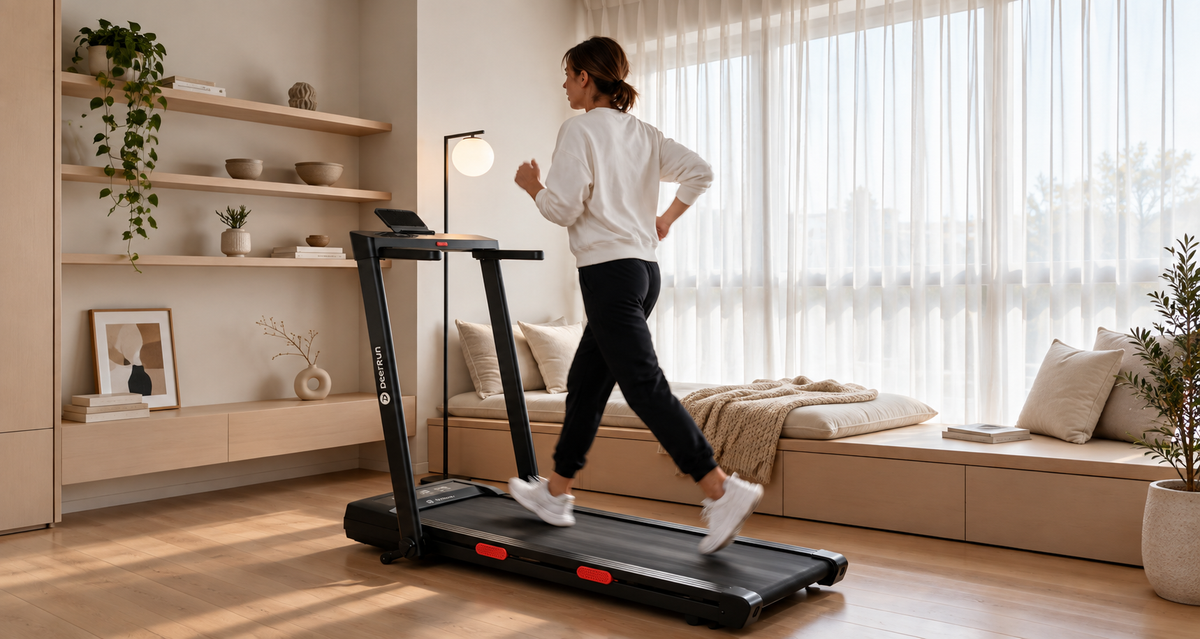
If you mainly use a Walking Pad while working from home, during work breaks or for faster everyday walking, the DeerRun Q2 Urban supports speeds from 1–6 km/h, covering everything from low-speed walking to a brisker everyday walking pace.
That makes it easier to use an under-desk treadmill or Walking Pad for different parts of the day rather than treating every walk as a formal workout.
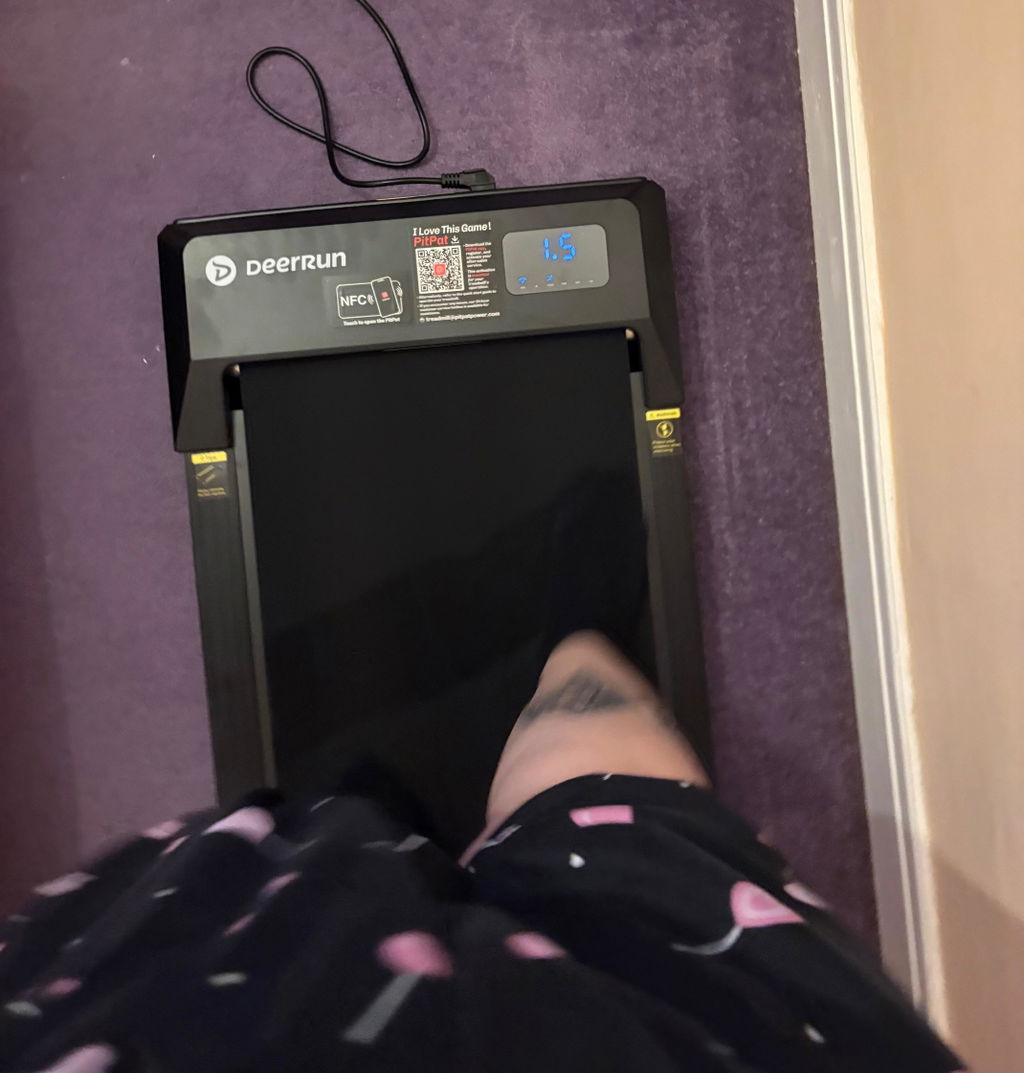
When paired with PitPat, you can also view steps, distance and workout time together.
Instead of tracking only one number, you can see both how much more you moved today and how far you walked over the course of the week.

Steps vs. Distance: Choose Based on Your Walking Goal
If your goal is simply to move more throughout the day, start with daily steps.
If you are completing a specific Walking Pad or treadmill workout, distance, time and speed are usually more useful.
And when your steps and distance do not seem to match, remember to consider stride length, walking speed and differences between tracking devices.
Instead of constantly asking whether you should track steps or distance, start by deciding what you actually want to measure:
- If you want to reduce sitting and increase daily activity, focus more on steps.
- If you want to complete a specific Walking Pad or treadmill workout, focus more on distance, time and speed.
- If you want to measure long-term progress over several weeks or months, use the same tracking method consistently and focus on the overall trend.
Daily activity: track steps.
Specific workouts: track distance.
Long-term progress: track consistent trends.
Effective fitness tracking is not about finding one number that works for everyone. It is about choosing a metric that matches your goal and that you can use consistently over time.
Make Every Walk Count
Whether you care more about daily steps or walking distance, find a tracking method that works for you and make regular walking part of your routine. Pair a DeerRun Walking Pad with PitPat to see steps, distance and workout time together.
Explore DeerRun Walking Pads →


Leave a comment
All comments are moderated before being published.
This site is protected by hCaptcha and the hCaptcha Privacy Policy and Terms of Service apply.