







Word Count: Approx. 1,300 words | Reading Time: About 6 minutes
When buying a treadmill, incline can be a surprisingly difficult number to compare.
One model goes up to 3%, another to 6%, and a third reaches 12%.
If the prices are similar, you might think:
“If I am buying one anyway, why not go straight for 12%?”
After all, a bigger number seems to offer more training possibilities.
But once the treadmill is in your home, a higher maximum incline is not necessarily better.
If you simply walk on the flat for 30 minutes every day, you may rarely use 12%. If, however, you enjoy changing the difficulty through incline and want more than one way to walk during a session, a wider incline range starts to show its value.
So before comparing which number is highest, look at how walking at 3%, 6% and 12% actually differs.
1. The same 30-minute walk feels different at 3%, 6% and 12%
Imagine keeping your speed at approximately 4.8 km/h (3 mph) while changing the treadmill from level to 3%, 6% and 12% incline.
It may look as though you have changed just one number, but the conditions in which you are walking have changed too.
For an adult weighing approximately 68 kg (150 lb), walking at approximately 4.8 km/h (3 mph) for 30 minutes, a commonly used exercise metabolic equation gives the following estimates:
| Incline | Estimated calories burned in 30 minutes* | Walking experience |
|---|---|---|
| 0% | Approximately 118 kcal | Level walking |
| 3% | Approximately 162 kcal | Walking at a gentle incline |
| 6% | Approximately 206 kcal | More noticeable uphill walking |
| 12% | Approximately 295 kcal | Walking at a steep incline |
*These figures compare theoretical differences at a fixed body weight, speed and duration. Actual energy expenditure also depends on factors such as movement efficiency and whether you hold the handrails.
Why does estimated calorie expenditure change when your speed stays the same?
Because increasing the incline changes the walking conditions, even at the same 4.8 km/h (3 mph). Research has also found that increasing treadmill incline at a fixed walking speed raises oxygen consumption and exercise demands.
This is one of the benefits of incline walking.
If walking on the flat at 4.8 km/h (3 mph) already feels familiar, increasing your speed is not your only option.
Keeping a similar speed and changing the incline can also change your workout.

2. A maximum incline of 12% does not mean you need to stay at 12%
Seeing “12% incline” may make it feel a long way from your everyday walking routine.
But buying a treadmill that reaches 12% does not mean using 12% every time.
The real value is having more incline options between level walking and 12%.
For example, a 30-minute incline walking workout could be divided into four stages:
| Time | Speed | Incline | How to walk |
|---|---|---|---|
| 0–5 minutes | Approx. 4.0–4.5 km/h (2.5–2.8 mph) | 0–2% | Walk gently to warm up |
| 5–15 minutes | Approx. 4.5–4.8 km/h (2.8–3.0 mph) | 3–6% | Settle into steady incline walking |
| 15–20 minutes | Approx. 3.7–4.2 km/h (2.3–2.6 mph) | 8–12% | Reduce your speed and try a steeper incline |
| 20–30 minutes | Approx. 3.7–4.2 km/h (2.3–2.6 mph) | 0–2% | Return to gentle walking and gradually finish |
This makes the meaning of 12% easier to understand. It is not about spending the whole session at the highest incline, but having another range available to use.
At a steeper incline, you do not have to maintain 4.8 km/h (3 mph). Reducing speed while increasing incline is another way to change the conditions of your workout.
If the maximum is 3%, most of the variation is within gentler inclines.
At 6%, incline walking can offer more noticeable changes.
At 12%, the range expands further, allowing you to progress from ordinary walking to steeper uphill walking instead of always increasing speed to make a session harder.
Of course, there is no need to force yourself to reach 12% simply because the machine can.
The maximum incline gives you a choice. It is not a setting you have to use in every workout.
3. Manual or automatic? How you adjust the incline affects how you train
During a workout with changing inclines, you move from level walking to 3–6%, then to a steeper incline, before returning to the flat.
This brings up a question that is easy to overlook when buying:
How do you adjust the incline?
If you set the incline before exercising and rarely change it during the session, manual incline can meet that need.
But if you want to change the incline several times during a walk, as in the example above, automatic incline is much more convenient.
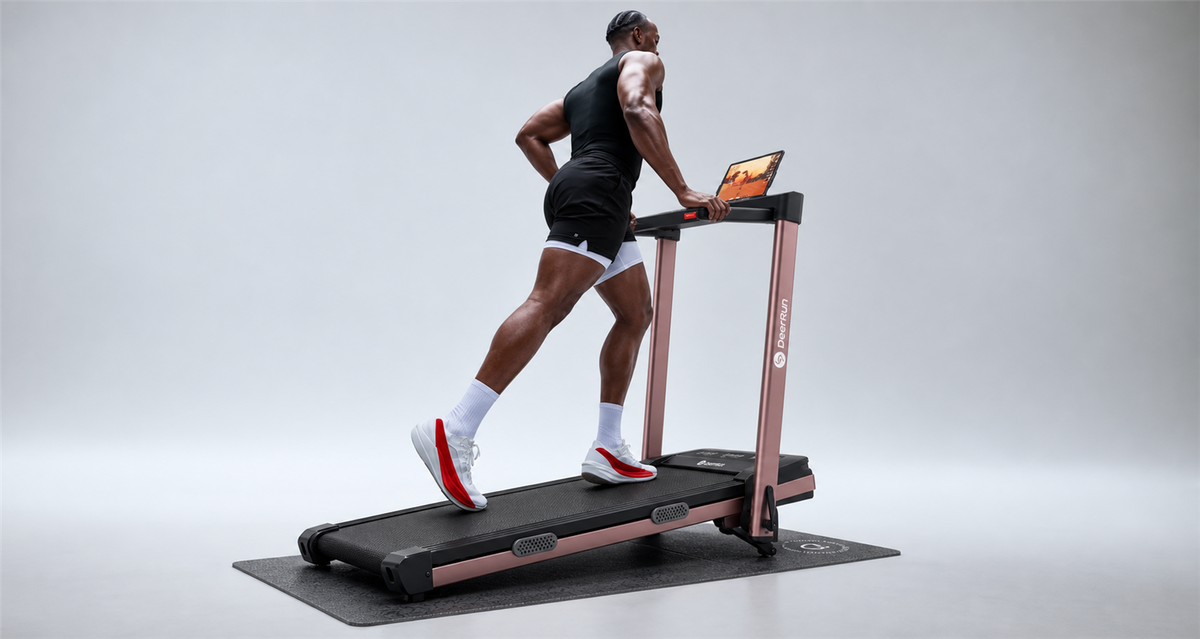
For example, the DeerRun Z10 Pro offers automatic incline up to 12%.
The point is not simply “up to 12%”.
During a session, you can start on the flat and move to a moderate incline. When you want a more noticeable uphill walk, increase it further, then lower it again towards the end.
You do not have to keep the whole session at one incline or repeatedly stop to adjust the machine.
So when comparing an incline treadmill, look beyond its maximum setting:
When you want to change the incline, is it convenient?
The incline range determines how many choices you have. The adjustment method determines whether those choices become part of your training.

4. A higher incline means little if you rarely use it
Before buying, you may carefully compare 3%, 6% and 12%.
When the treadmill first arrives, you are keen to experiment:
Try 3% today, 6% tomorrow and perhaps 12% next time.
But after a while, you still find yourself unsure how to organise a session whenever you switch it on.
Eventually, you return to:
The same speed, the same incline and the same 30 minutes.
It is not that the machine has no other features. Having more options also means knowing how to use them.
This is where the Z10 Pro and PitPat AI Coach can work together.
The Z10 Pro offers automatic incline up to 12% and speeds up to 12 km/h (approximately 7.5 mph), making both speed and incline variables in your training. PitPat AI Coach connects training, content and data, using workout feedback and ongoing adjustments to help your next session become more than a repeat of the last.
What you buy is therefore more than a “12%” specification.
It is room to vary your training in ways you actually use.
The treadmill gives you more choices; AI Coach helps bring those choices into your everyday workouts.
Do not judge a treadmill by its maximum incline alone
There are differences between 3%, 6% and 12%.
At the same speed and duration, changing the incline changes the demands of walking and its estimated calorie expenditure. A wider incline range also gives you more ways to vary a session.
But that does not mean:
12% is always a better buy than 6%.
If you only walk on the flat once it arrives, 12% may simply remain an attractive number on the specification sheet.
But if you already want to vary your workouts through incline walking, moving between level, moderate and steeper settings, a wider incline range and automatic adjustment can become useful.
So next time you see “12% automatic incline”, do not only ask:
“Is it higher than 6%?”
Also ask:
“How will I use it?”
The maximum incline only tells you what the machine can do.
What determines whether it is worth buying is whether you can make those inclines part of your workouts.
Ready to make use of incline?
Do not pay simply for a bigger number. Choose a treadmill that gives your workouts more variety.
Explore DeerRun Z10 Pro →


Leave a comment
All comments are moderated before being published.
This site is protected by hCaptcha and the hCaptcha Privacy Policy and Terms of Service apply.