







Word Count: Approx. 1,300 words | Reading Time: About 6 minutes
If you are planning to use a walking pad under your desk, the most important thing is not how fast it can go. It is whether it can keep you moving without interrupting your work.
For people who work from home, a walking pad that actually works well should get a few things right: comfortable and controllable low speeds, a natural upright walking position, noise that does not overly disrupt meetings, and quick storage when the workday is over.
Those are exactly the kinds of situations the DeerRun Q2 Urban is designed around. Its speed range, dimensions, walking belt, noise level and storage design are intended to make walking easier to fit into the working day, rather than adding features you are unlikely to use while working.
1. You Don’t Need High Speeds to Walk While You Work
For walking while working, comfortable and controllable low speeds matter more than maximum speed.
When you are answering emails, reading documents or organising your schedule, you do not need to walk particularly fast. Going too quickly can actually make typing, looking at a screen and using a mouse more difficult.
When you are just starting, try walking at around 1.3–2.4 km/h. Keep an easy pace while handling simple tasks, then slow down again when you need to concentrate more.
The DeerRun Q2 Urban has a 1–6 km/h speed range, making it well suited to this kind of low-speed desk walking. During the working day, the speed you use most often probably will not be the maximum. What matters is finding a pace that lets you keep walking while still getting your work done.
2. Fitting Under Your Desk Isn’t Enough—Its Height Should Work with Your Workspace Too
An under-desk walking pad needs to be compact, but it also needs to allow your overall working posture to stay natural.
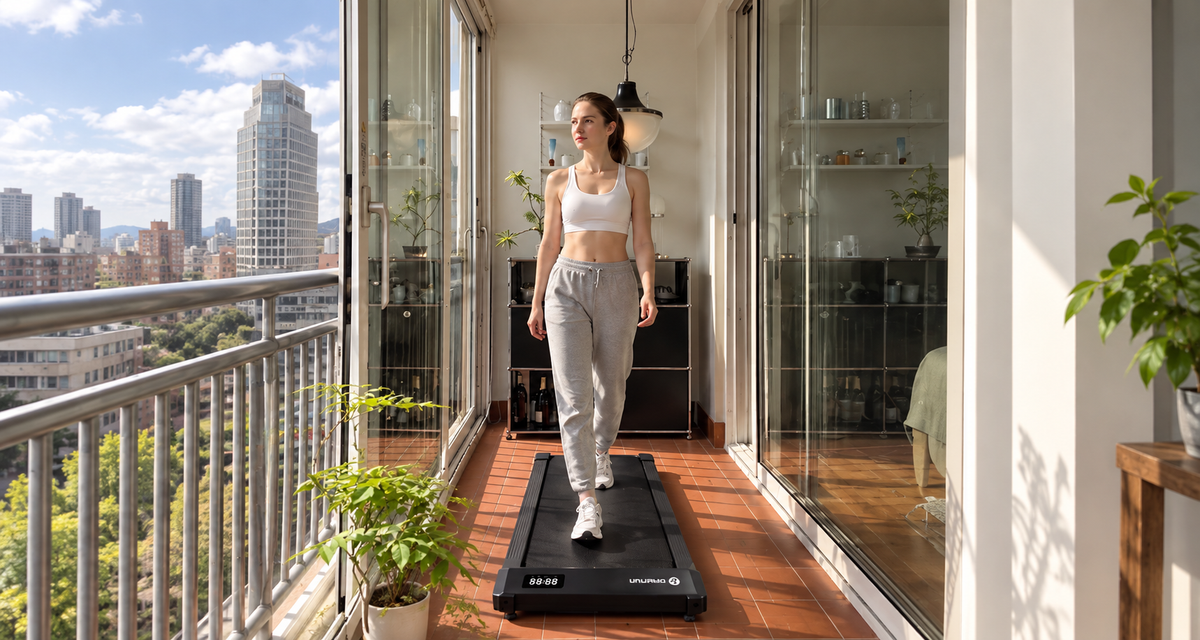
The DeerRun Q2 Urban measures approximately 108.2 × 50 × 10 cm, with a footprint of about 0.54 m²—roughly comparable to the floor space of a small coffee table.
At only 10 cm high, its low-profile design takes up relatively little vertical space beneath a standing desk, making it easier to integrate into an existing home-office setup.
The benefit of this low-profile design is straightforward: when you step onto the walking pad, you are not raised too far from the floor, making it easier to keep the desk surface around elbow height for comfortable typing and computer work.
When you are not using it, the 10 cm profile also makes it easier to use low-clearance storage areas beneath a desk, beneath a suitable bed or near a sofa, rather than having to dedicate a large part of the room to a walking pad.

3. If You’re Looking at a Screen While Walking, the Walking Belt Should Let You Move Naturally
Your attention will not always be on your feet while you are working, so the walking belt needs enough room for your stride to remain natural.
The DeerRun Q2 Urban has a walking belt measuring approximately 90 × 38 cm. At the low speeds typically used while working, where your stride is shorter, this provides practical walking space for everyday desk use.
When you are looking at a screen, typing or using a mouse, you should not need to keep watching your feet simply to maintain a steady walking rhythm.
For WFH use, a larger walking belt is not automatically better. What really matters is this:
When your attention shifts back to your work, you should still be able to walk naturally.
That is why the criteria for choosing an under-desk walking pad are not exactly the same as those for choosing a traditional treadmill. You are not trying to reach a higher running speed. You are looking for a way to move that does not significantly disrupt your working rhythm.

4. If You Want to Walk During Meetings, Noise and Speed Controls Shouldn’t Get in the Way
If you plan to use your walking pad during meetings, calls or everyday office tasks, noise and the way you control the machine can directly affect whether you actually want to turn it on.
The DeerRun Q2 Urban has a rated operating noise level of under 45 dB, making it better suited to home-office environments where background noise matters.
Actual sound levels will still be affected by factors such as walking speed, footsteps, footwear and flooring, but the machine itself is designed to operate quietly, helping reduce its presence in the working environment.
The same principle applies to speed control.
The DeerRun Q2 Urban supports remote control operation. You can slow down when a meeting starts, pause when you need to concentrate, and continue again once you have finished the task without repeatedly bending down to operate the machine itself.
If you already use PitPat, you can also record your daily activity along the way. Its value here is not to make the walking pad more complicated, but to reduce the number of extra steps involved.
Your work continues as usual. Walking simply becomes part of it.
5. Thirty Minutes a Day Doesn’t Have to Happen All at Once
If you are just starting to add a walking pad to your working day, you do not need to begin with one long continuous session.
You can start with a simple 3 × 10-minute WFH walking routine.
| Time | Walking Pace | What You Can Do |
|---|---|---|
| Morning — 10 minutes | Around 1.3–2.4 km/h | Answer emails, check your schedule or read simple documents. |
| Midday — 10 minutes | Around 2.4–3.2 km/h | Step away from highly focused work and simply walk, listen to something or take a short mental break. |
| Afternoon — 10 minutes | Around 1.3–2.4 km/h | Fit it around meetings, organising tasks or routine work. |
Thirty minutes of walking across the day does not have to happen all at once.
A walking pad that genuinely suits working from home should make those three 10-minute sessions easy to fit into the day.
6. When the Workday Is Over, It Shouldn’t Keep Taking Up the Room
If it is easy to take out during the day, it should also be easy to put away in the evening.
The DeerRun Q2 Urban takes about 5 seconds to go from storage to ready-to-use. When you want to walk during a work break, you do not need to spend several minutes rearranging the room before getting started.
With a footprint of about 0.54 m² and a profile of only 10 cm, it can be stored beneath a desk, beneath a suitable bed or near a sofa when the working day is finished.
For WFH users, this kind of storage has a very practical benefit: during the day, it is a walking pad you can use while working; in the evening, the room can return to its original purpose.
What you are really saving is not just space, but also those few minutes before every walking session.
7. The DeerRun Q2 Urban Is Built Around the Needs of WFH Walking
If your main goal is walking while working from home or using a walking pad beneath a standing desk, the DeerRun Q2 Urban brings together several of the features that matter most in this setting:
- 1–6 km/h speed range: suitable for low-speed walking while answering emails, reading documents or joining meetings.
- 90 × 38 cm walking belt: provides practical walking space for natural, steady movement at low desk-walking speeds.
- 10 cm profile: easier to use beneath a standing desk and to store in low-clearance spaces near a bed, sofa or desk.
- Approximately 0.54 m² footprint: roughly comparable to a small coffee table, so it does not need to permanently occupy a large part of your home office.
- Under 45 dB rated operating noise: better suited to meetings, calls and everyday home-office use where background noise matters.
- Remote control: makes changing speed or pausing more direct while working, without repeatedly bending down to operate the walking pad.
- About 5 seconds to get ready: makes it easier to start walking during a short work break and put the machine away again when the working day is over.
For people who work from home, the advantage of the DeerRun Q2 Urban is not that it gives you “more features”. It is that it makes walking while working easier to turn into something you can actually do every day.
Bring Walking Into Your Workday
Keep your workday moving as usual while adding a little more activity to your day with the DeerRun Q2 Urban.
Explore DeerRun Q2 Urban →


Leave a comment
All comments are moderated before being published.
This site is protected by hCaptcha and the hCaptcha Privacy Policy and Terms of Service apply.