







Word Count: Approx. 1,400 words | Reading Time: About 7 minutes
If you are already used to running at the gym and now want to move your training home, the most important question is not, “Will a home treadmill be much smaller than a commercial one?”
It is whether these five things can still work for you: you can run at the speeds you normally use, the running belt feels comfortable enough, you have a space at home where the treadmill can stay long term, speed and incline can adjust to how you feel that day, and the time you save comes from commuting and waiting—not from cutting back your actual training.
If all five line up, only your training location needs to change. Your original running plan does not have to start again.
1. Start with How You Actually Run, Not Just the Maximum Speed
If you already have a consistent running habit, the first thing to check is whether you can continue using your usual speeds at home.
During an Easy Run, the treadmill should let you complete the session steadily. When you are feeling good and want to pick up the pace, there should still be some room to increase your speed. And if you occasionally add a few faster segments, you should not immediately hit the machine's limit.
The DeerRun A1 Pro Move+ has a 1–16 km/h speed range, with its maximum speed roughly equivalent to a 6:02 min/mile pace. From warm-up walking and easy jogging to faster-paced running, it covers a broad range of everyday training needs.
Of course, that does not mean you need to run at 16 km/h every time. What matters more is that after moving your workouts from the gym to home, you do not have to turn your usual running session into walking simply because the treadmill cannot go fast enough.
If a home treadmill can only support your easiest training right now, it may quickly start to feel limiting as soon as you want to increase the pace.
Instead of focusing only on top speed, compare the treadmill with the workouts you actually do. Make sure your usual pace feels natural while leaving some room for future changes.
2. If You Run for 20–40 Minutes, Comfort Matters More Than “Small”
A home treadmill obviously needs to fit your space, but saving floor space should not mean sacrificing the space you actually need for running.
This is especially important if you are already used to running continuously for 20–40 minutes, because the length and width of the running belt can directly affect how the workout feels.
A belt that feels large enough for walking may feel completely different once you start running, particularly when you increase your speed.
If the belt is too narrow or too short, you may unconsciously shorten your stride and become more aware of where your feet are landing. At first, it may simply feel less relaxed. After 20–40 minutes of continuous running, that restricted feeling can become much more noticeable.
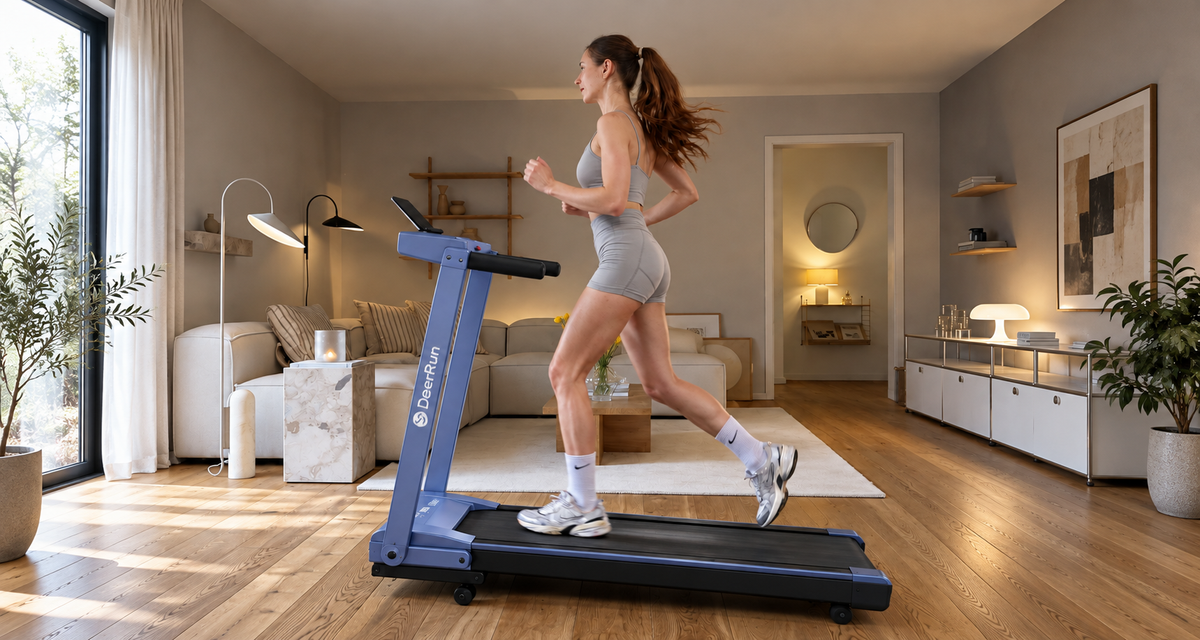
The DeerRun A1 Pro Move+ has a 112 × 42 cm running belt, providing practical room for natural foot placement and stride during everyday home running without requiring the amount of space taken up by a commercial gym treadmill.
So before buying, do not just look at how small the treadmill becomes when stored. Also ask:
- Can your stride remain natural while running?
- Do you still feel stable when you increase the speed?
- Will the running-belt space make you constantly think about where your feet are landing?
The treadmill can be compact, but when it is unfolded, it still needs to feel like a machine you can genuinely run on.
3. It Needs to Fit Your Home—and Leave Enough Room to Run
At the gym, you do not need to think about how much living space a treadmill takes up.
Once you bring one home, it has to share space with your bedroom, living room or another part of your home. That means the treadmill's dimensions and placement need to be planned in advance.
The DeerRun A1 Pro measures approximately 139 × 61.3 × 107.5 cm when unfolded, with a footprint of about 0.85 m²—roughly comparable to the floor space of a small desk.
At this size, it makes more sense to reserve a dedicated running area at home rather than moving the treadmill around and searching for a place to put it every time you want to use it.
In addition to checking whether the treadmill itself fits, make sure there is enough space around the front, back and sides to get on and off the machine and move comfortably.
If saving a little floor space means choosing a treadmill that does not feel comfortable to run on, it can undermine the whole point of training at home.
The ideal setup is one where the treadmill fits naturally into your home without requiring you to rearrange the room every time you want to run.

4. You Don’t Run the Same Way Every Day—So Speed and Incline Should Be Adjustable
Once you have developed a regular running habit, you probably do not run at exactly the same speed every time.
Some days are Easy Runs. Other days, you may want to pick up the pace slightly. When you are not feeling your best, you might only complete a shorter session. And occasionally, you may use incline to add some variety to your training.
Ideally, your treadmill should adjust to how you feel and what you want to accomplish that day instead of locking you into one fixed training style.
The DeerRun A1 Pro offers a 1–16 km/h speed range, allowing you to move gradually from easy running to faster paces, while its 6% manual incline gives you another way to adjust the workout.
For example, if you do not want to keep increasing your speed that day, you can introduce some incline instead. If you are doing an easy recovery session, simply keep both speed and incline lower.
That means different workouts throughout the week do not have to repeat exactly the same pattern.
Monday can stay easy. Midweek, you can change the pace. When you are feeling good, you can increase the training difficulty.
For everyday use, this kind of flexibility is often more practical than chasing one impressive maximum specification.
5. What You’re Really Saving Is the Time Before and After Your Run
A 30-minute run at the gym usually takes more than 30 minutes out of your day.
You have to change, leave home, commute, enter the gym, possibly wait for equipment, complete your workout and then travel home again. One session can easily take much longer than the actual running time.
And when weekdays get busy, “Should I go to the gym today?” can quickly turn into “I’ll run tomorrow instead.”
Moving your runs home removes many of those extra steps.
If you only have 20 minutes today, you can complete a 20-minute Easy Run. If you only have 15 minutes, you can still fit in a short run instead of cancelling your workout because you do not have a full hour available.
For someone who already has an exercise habit, the biggest value of a home treadmill is not helping you create an entirely new routine.
It is making the routine you already have easier to continue.

Your Training Location Changes. Your Running Rhythm Doesn’t Have to Start Over
Moving from the gym to your home does not change your training goals.
If you are already used to tracking your runs, there is no reason for every home workout to suddenly become a random session where you simply “run a little today”.
PitPat AI Coach can continue recording each workout and help keep your home runs connected with the rest of your weekly training.
How long you ran, how many sessions you completed that week, and when you increased your speed or incline can all continue to be recorded.
DeerRun A1 Pro brings your running home. PitPat helps you keep the training rhythm you have already built.
Conclusion | Bring Your Running Home—Not a Smaller Version of Your Training
If you are already used to running at the gym, choosing a home treadmill does not necessarily mean finding a machine that completely replicates commercial gym equipment.
What matters more is confirming:
- Can you still run at your usual speeds?
- Is it comfortable enough for continuous training?
- Can it stay in your home long term?
- Can it support your different training needs throughout the week?
What is worth cutting out is the commute, waiting and preparation time—not the running habit you have already built.
Bring Your Running Home—and Keep the Rhythm You Already Have
Use the DeerRun A1 Pro + PitPat AI Coach to support your everyday training, so your training location can change without forcing your running plan to start over.
Explore DeerRun A1 Pro →



Leave a comment
All comments are moderated before being published.
This site is protected by hCaptcha and the hCaptcha Privacy Policy and Terms of Service apply.